Front door styles across the eras – Part 1
Choosing a new front door for your home can be a difficult decision. Homeowners today are blessed with more choice than ever before. Advances in production techniques as well as greater consideration to style and taste, in addition to the ability to create a bespoke solution, allow you to create a door that is truly you. A new front door can really put your stamp on your home, while increasing its value and beauty at the same time.
Many of the various styles of door available on the market today, are either heavily or directly influenced by certain eras in our countries’ past. Today is the first of two posts, where we will look at these different periods, and how styles of front door have evolved over the years in line with advances in society and ways of living. Today we will cover the earliest periods of influence, namely the Tudor, Jacobean, Queen Anne, Georgian and Regency eras.
In a later post, we will cover the remaining eras that take us to the modern day, including the Victorian, Arts & Crafts, Edwardian and Interwar periods, as well as looking at the more modern day, contemporary styles.
Tudor Era
The Tudor era in England lasted from 1485-1603. Front doors during this time were very rustic, and mediaeval in their appearance. They were mostly made from heavy, solid oak, often with hand-forged iron studs adorning the door. The doors were either fully planked with no visible glass area, or with a small peephole or iron grill.
Colour finishes during this era essentially did not exist, and all doors were finished in a dark oak, or traditional wood stain finish. Arched tops were a common feature during the era as well, which, given the manufacturing and most hand-crafted nature of entrances at the time, was an impressive feature that has stood the test of time to this day. Original Tudor doors can still be found today on historic structures, castles, fortresses etc, although most do not still function as intended, given they will have mostly warped beyond a point of operation. However, to remove these doors, would be an insult to the building it adorns and the period it is from.
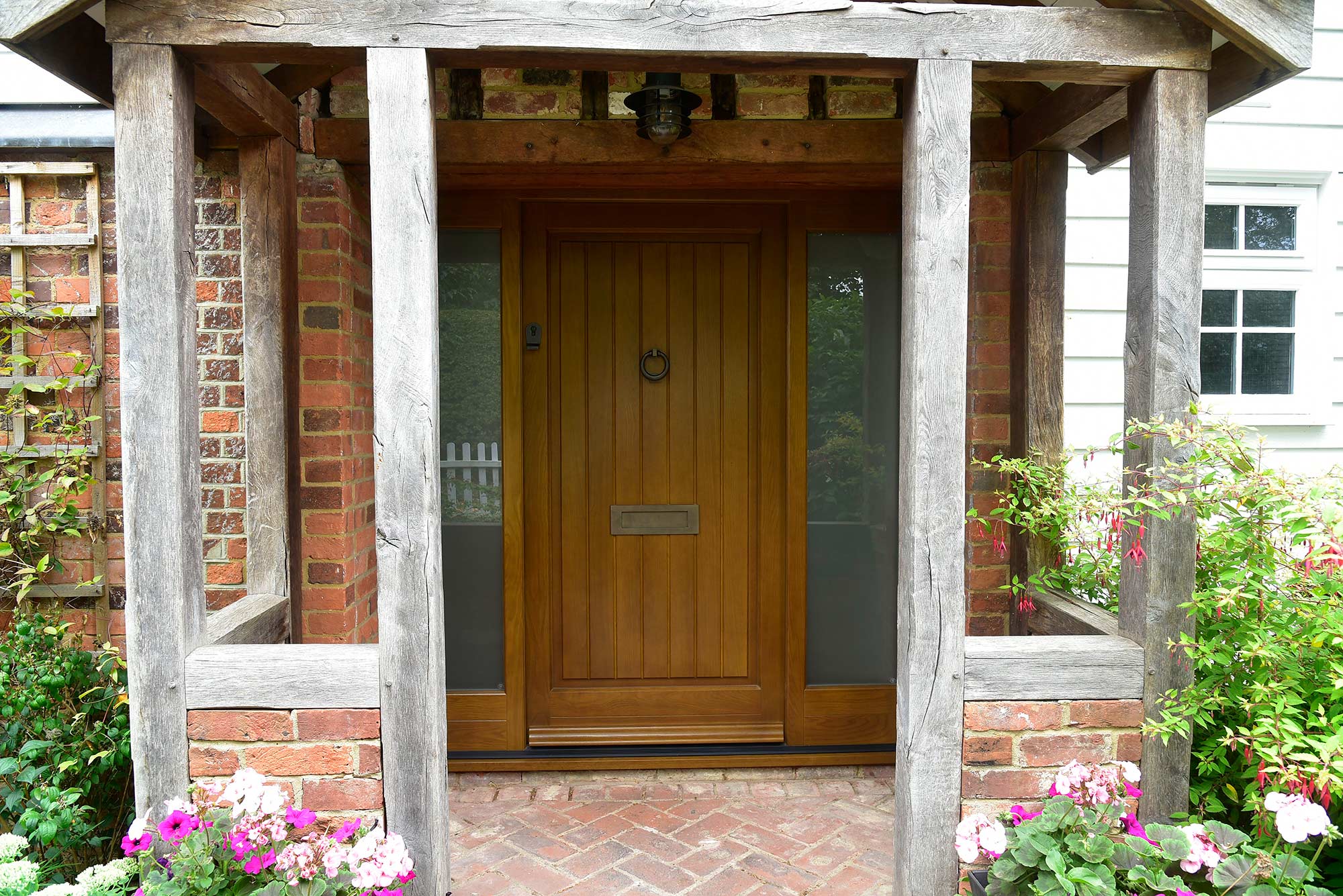
The Timber Windows range includes a few door styles inspired by this period, namely our Rawlinson, Norham, and ever popular Staverton styles, which you can see an example of below. The Rawlinson style especially (fully panelled, no glass) is also a popular, and widely adopted style of internal door that you can find in properties of almost every era across the country, a testament to the legacy of the Tudor era.

Jacobean
This smaller era in our nation’s past spanned from 1603-1625, covering the reign of James VI of Scotland, who also inherited the crown of England as James I. The era was named for Jacobean architecture, which marked a progression in renaissance style, and a gradual move away from the more rustic, Tudor style architecture that had preceded it, towards a more Elizabethan style.
Doors also began to change during this time, with key features of this era being:
- A shift towards more panel-built doors, less rustic in appearance compared to their Tudor predecessors.
- Geometric style panels – square/lozenge shaped panels making up a full door.
- Carving / shaped work – Advances in framed construction allowed for front doors to sit within ornate frames and surroundings, marking a substantial progression in style.
- A continuation of dark oak / stained finishes – Colours mostly remained the same as the Tudor era, however, the progression in style of architecture surrounding these doors elevated the overall design and finish.
The Queen Anne Era
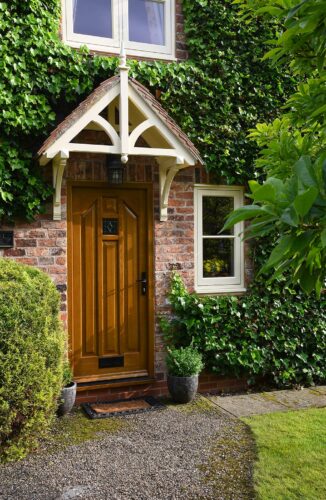
The next marked progression in front door style came during the reign of Queen Anne at the beginning of the 1700s, with architecture during this period often referred to as Baroque. As with the progression in sash window style (which we cover in greater detail in a separate blog post), manufacturing and production advancements during these years allowed for a greater step forward with styles and options of doors, including the following key differences:
- Panelled doors (often with 6) became the standard, bringing a softer overall look and a more elegant finish.
- Door toplights / fanlights began to be more widely adopted, often with a semi-circular wooden or glazed panel.
- Decorative door surrounds and pilasters featured on more buildings as construction techniques continued to improve, allowing buildings to have more character.
- More colour finishes became available – the days of a pure timber stain finish had passed, and a small palette of colours such as greys, cream and certain shades of green became viable options for front doors.
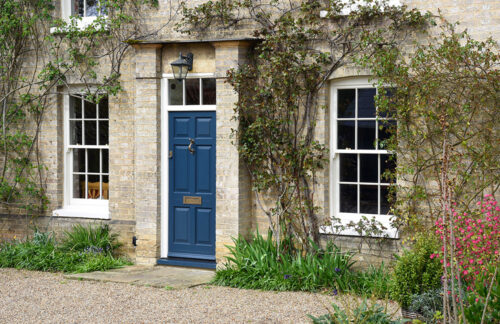
Georgian Era Front Doors
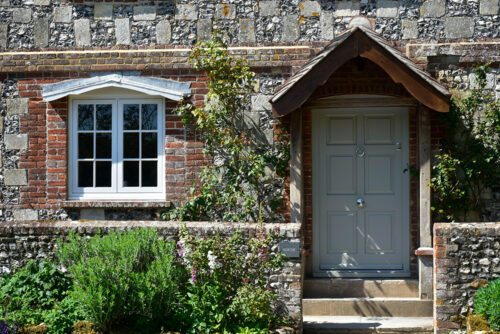
From an architectural perspective, the Georgian era saw a period of symmetrical and proportional designs. When we covered the different eras of sash window, we noted how a Georgian sash window has square glazing bars to the upper and lower sashes, creating a balanced, symmetrical look. This desire for symmetry also dictated that front doors were placed centrally within a façade. Numerous examples of this style of architecture can be found across the country, especially in farmhouses, grand country homes and within cities like London for example. From our own range, our Chadlington style door is a perfect example of a traditional, Georgian front door, and while perfectly suited to the era, can also be found on a great variety of property styles, including Victorian townhouses.
Some other key aspects of a Georgian era front door are:
- Six panelled doors continue to grow in both popularity, and application. Raised and fielded panels had also been introduced. Glass was not often incorporated within a Georgian front door.
- Door fanlights, pilasters, and ornate details continued to progress and be increasingly applied to entrances to properties.
- High quality Brass door furniture became the norm and often, expectation, especially door knockers and knobs (letterboxes were not available at this point).
- A greater number of paint finishes were available. Blues, Greens, Black and Red were especially popular during the Georgian era.
Regency Era
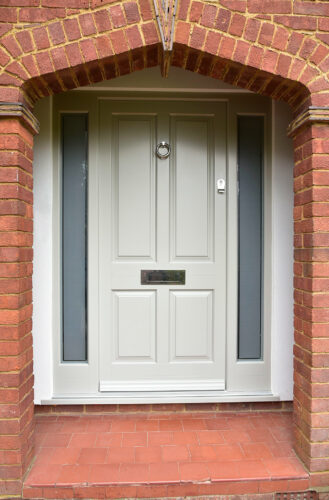
The final era we will be covering in this post is the Regency era (1811-1837). This period saw further advancements of the Georgian era innovations listed above. However, influences from both Greek and Egyptian cultures began to seep into our society and influenced both tastes and desires. This was also the case with front door styles. Some key features of the Regency era include:
- A continuation of the 6-panel style of door, while also introducing a 4-panel style door in addition. Our Bevington style door is a perfect example of this.
- Finer detailing became more prevalent, especially in fanlights/toplights, as well as the introduction of slimmer glazing bars and an increase in the number of shapes that could be manufactured.
- Door surrounds and pilasters continued to evolve, with reeding and fluting details being introduced.
- Colour choices continue to increase, with this era seeing the rise of lighter shades, such as creams, white and pale shades.
- During the latter phase of the Regency period, clear glass began to appear in front doors, signalling a change from a solid timber front door that had been the standard (in various forms) for centuries.

New Timber Front Doors
Looking back through the various eras in this country, you can see how a front door has evolved from a heavy, ‘slab’ of timber, to an increasingly elegant, and stylish, key feature of a home and/or building. Advancements in technologies, evolution of styles and tastes, and an increase in influence from other cultures and societies have shaped and continue to drive the evolution of front doors and nowadays, is a key way to put your stamp on your home, as well as increase its value and beauty with one, simple change.
At present, we offer 55 different front door styles, that range from as traditional as a Tudor style door, to a sleek, modern, contemporary door style, and all eras in between! We will cover the other main eras of influence in a future blog post, however, if you are thinking of improving your home with a new front door, then please explore our range here. If you visit your local showroom, you can also pick up free copies of our Door Portfolio (with 300 different doors to serve as inspiration) and our Choices brochure, where you can see drawings of these 55 styles, as well as browse the various hardware, glass, and colour options available to you.