Front door styles across the eras – Part 2
In a previous post, we began to look at how the style of front door has adapted, grown, and changed over the past centuries. We began with the Tudor era, where a door was a heavy, fully planked slab of oak, which was very mediaeval and rustic in its look. As society began to progress and new technologies and manufacturing techniques were adopted into building homes and front doors, we finished our post during the Regency Era at the beginning of the 19th century. During this time, glass was playing a larger role within front doors, intricate detailing was possible with door mouldings and a greater variation in colour finishes were possible.
Today is our second post looking at how front door styles have evolved over the years, picking up where we left off last time and covering the eras leading up to modern day Britain. Namely, today we will cover the Victorian, Arts & Crafts, Edwardian, Interwar, and modern-day periods.
Victorian Era Front Doors
Following the ascension of Queen Victoria in 1837, this marked the end of the Regency era in the country, and the beginning of the Victorian. The Victorian era was a significant, highly renowned period in our history and architecturally speaking, is one of the most prevalent even today across numerous buildings in cities and towns throughout the nation.
In a previous post, we covered Victorian sash windows (fully glazed, or with a singular, vertical glazing bar). These are especially prevalent on terraced homes, and townhouses, and when combined with a Victorian front door, are a beautiful testament to this significant era in our history. As our country’s longest serving monarch (until Queen Elizabeth II), this era spanned many decades, up until her passing in 1901.
With front doors, style and capabilities continue to progress during this era, with some key features of Victorian front doors including:
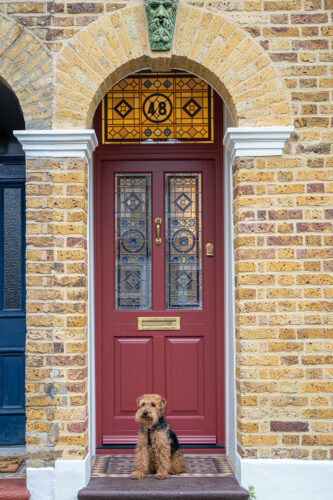
- A greater adoption of the four-panel style of front door, with the upper two panels often being glazed. Our Kingston door is a perfect example of this.
- An increase in the number of toplights, that allowed for a greater degree of light into the building. These would often have a house number or name in its design.
- From around the 1870s onwards, stained and etched glass designs were adopted more in residential settings, which allowed for much greater individualisation and personality to show.
- Colour palettes continued to evolve. The Victorian era saw a greater degree of rich colours being used for a front door, such as reds, greens and blues.
- Door surroundings became increasingly decorative, with floor tiles leading up to the door becoming a feature of many homes.
- More elaborate hardware became possible, with brass and cast-iron work increasing. Lion heads and floral designs especially were popular during this time.
Arts & Crafts Era
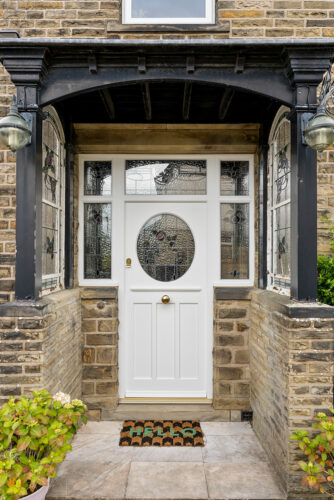
The latter period of the Victorian era coincided with the Arts & Crafts movement, which began in the UK and spread worldwide (circa 1880s). The movement is synonymous with fine arts and decorations, which ultimately, extended to property and architecture as well. Consumer tastes shifted towards more intricate, hand crafted work using natural materials such as hard and soft wood.
The movement was driven by John Ruskin, who criticised the progressions made during the industrial revolution. He believed automated machinery, and division of labour was dishonest and servile, while handwork and expert craftsmanship brought dignity to labour, allowing people to hone and improve their skills.
Some key features of front doors during this period were:
- Plank and panelled doors displaying this skill of joinery were prevalent.
- Smaller glass areas in the upper parts of the door were used. Leaded in glass was very popular during this time as was the Bullseye pattern.
- Door surroundings and canopies were simpler in design, due to their handcrafted nature. Timber canopies were especially prevalent.
- A more subdued colour palette was preferred, with stained finishes and natural colours increasingly adopted.
The movements made during the Arts & Crafts era can also be seen in casement windows with some of the design features outlined above. Arts & Crafts style casement windows are often stained finished, with leaded patterned glass. This can be especially prevalent in areas surrounding London and in rural parts of Surrey for example.
Edwardian Era
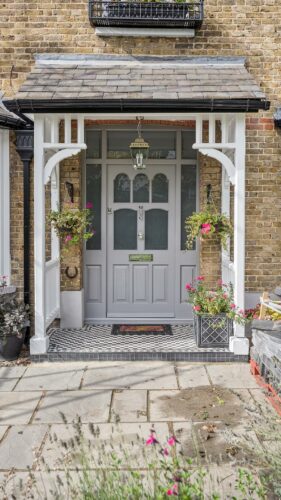
A smaller, yet significant era in our history was during the reign of King Edward VII from 1901 – 1910, while some scholars extend the era itself to include the beginning of the First World War in 1914. During this time, Art Nouveau influences crept into society, creating a form of blend between the Arts & Crafts, and Victorian movements that preceded it, albeit with lighter styling, and more restrained design considerations compared to the Victorian era. Popular features in front doors from the Edwardian era include:
- Four or six panelled doors, with the upper half glazed with either frosted/obscure or decorative glass.
- Geometric and floral designs increasingly used in glass.
- Porches and surrounds used square or turned details, with tiled steps and pathway. Mosaic tile designs also became more popular.
- Softer colours, such as creams, white, greens, were preferred.
Interwar Era
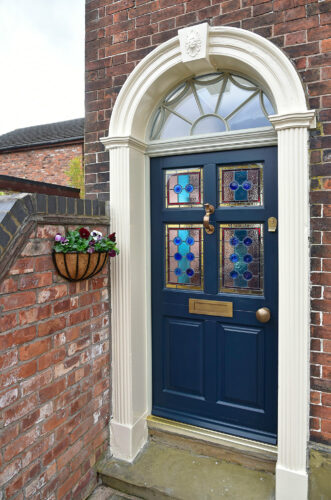
Moving forward, the aptly named Interwar period in England spanned the two world wars, between 1918 – 1939. Synonymous with both the roaring twenties, followed by the great depression, from an architectural point of view this period saw a revival of some previous styles, in newer forms. This includes:
- Mock-Tudor style doors with small glass panes, planked doors, and Black hardware.
- Art Deco style – geometric glass patterns, Chrome hardware, decorative door shelves / rail detailing.
- Neo-Georgian – 6 panel doors, symmetrical in design, with Brass hardware in a classical surrounding.
- A return to deeper colour shades became popular again, while an increasing use of creams/whites with porches or surroundings were incorporated into the façade.
- Etched, patterned and stained-glass designs became increasingly popular.
Contemporary Timber Front Doors
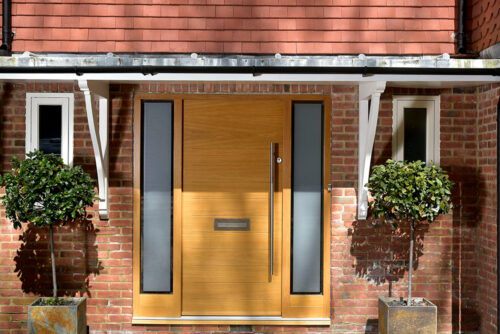
Fast forwarding to today’s climate, as a contrast to the styles outlined above and in our previous article, an option available for homeowners today are sleek, contemporary style front doors. This is especially prevalent on new build housing estates, apartment buildings, and on homes where the homeowner has a more, minimalist, modern taste.
Key features of these newer, contemporary style doors are:
- Smooth, singular panels with either grooves, or flat plank styling.
- Square moulding details, less intricate and ornate than traditional doors.
- Sandblasted glass incorporating an etched house number or name, or clear vision panel. Stained and etched glass designs are not appropriate for this look.
- An increase in the use of Brushed / Satin hardware finishes, over a traditional Polished finish.
- A revival in stained finishes, in addition to soft forms of Grey and Blue.

New Timber Front Doors Options for your Home
From the Tudor era to the modern day, the front door has evolved from a simple slab of wood to a key design feature of a home, that is often the first thing we notice when we look at a property. Modern technologies, as well as a great variation of styles of architecture across the country, allow all these eras discussed to still shine today in a modern context. Manufacturing techniques, combined with styles have also allowed for some of these eras to blend, as the ability to create a truly one-of-a-kind entrance is a possibility for homeowners. When combined with bespoke stained glass, colour finishes limited only by your imagination, and a great choice with regards to hardware than ever before, you can transform the look of your home with one simple change.
Any change to a front door must always be in keeping with the style and architecture of your home. When a door, or windows, are wrong, you can spot this immediately. For example, it wouldn’t be correct to put a modern, sleek contemporary front door, on a traditionally symmetrical Georgian home. The clash would be apparent.
When looking at a new front door for your home, neighbouring properties, or homes of a similar style to yours can be a useful starting point. What worked for them? And how would you adapt it to put your stamp on it? Our showrooms display an extensive selection of our timber front doors, from a range of eras, in a warm and welcoming environment. We also have a selection of literature, including our Door Portfolio, to inspire further and present what can be done with our range.
If you are thinking of improving your home with a new front door, then please explore our range here. You can also find your local showroom here, where our literature including the Door Portfolio and our Choices brochure are on hand. Here you can see drawings of these 55 styles, as well as browse the various hardware, glass, and colour options available to you.